SCIENCE-BACKED · FREE · 5 MINUTES
You’re More Than a Mood. Measure All of It.
Most tools tell you how you feel right now. MAP shows you why. And precisely where one focused change can shift everything else.

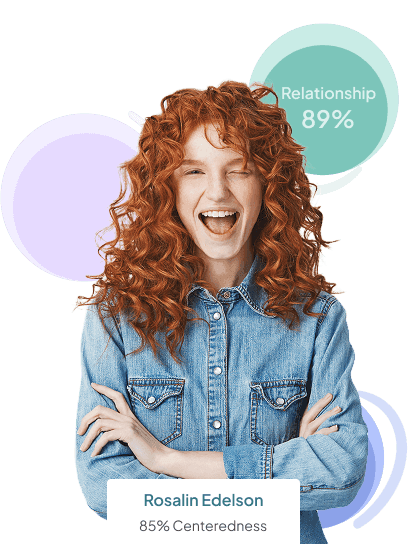
What Makes MAP Different
Most tools measure one slice of who you are. MAP measures twenty
Your life spheres don't exist in isolation. They form an interconnected system — which means a problem at work affects your relationships, and a strong family life can buffer stress everywhere else. MAP builds a complete picture of your wellbeing, then shows you where to focus.
See the Complete Picture
MAP scores you across 20 dimensions in five life spheres — Self, Family, Relationship, Work, and Community — and surfaces patterns you can't see on your own.
Find Where One Change Makes Everything Better
Using Centeredness Intelligence, MAP pinpoints your single highest-leverage dimension — one of twenty — where focused effort creates improvement across your entire wellbeing, not just one corner of it.
Act on Evidence, Not Guesswork
MAP draws from peer-reviewed interventions to surface specific steps matched to your profile. Nothing generic. Nothing unsubstantiated.
Track Real Progress
Work through a personalized program and watch how change in one sphere creates momentum across the others.
Your Experience
Clarity is the starting point. MAP gives you that. And what to do next.
Your wellbeing, made measurable.
Goals don't fail because you lack willpower. They fail because something deeper needs attention first. MAP makes the invisible visible: here's what's strong, here's what's being overlooked, here's what deserves your attention next.
No two profiles look alike, because no two lives do. Take five minutes and discover yours.
Real results
What people find when they look clearly.
Real results from real assessments across 38 countries.
 Kai, USA
“Two years ago, MAP flagged a low score in my relationship sphere. I brushed it off — thought things were fine. Fast forward and, surprise surprise, the relationship broke down. The signs were all there. It’s like having a mirror I can’t argue with.”
MAP’s relationship sphere score discovered the problem two years before it became undeniable.

In the daily rat race, I’d lost the ability to find joy in ordinary things. MAP quantified that feeling of lostness and gave me a simple list of actions I could actually take — for myself and my community.

I had a rough sense of where I stood, but struggled to articulate what would actually help. MAP validated what I was feeling and made it actionable. Such a fan.
The Story Behind MAP
Humanity’s Oldest Questions. Now you can answer them.
Aristotle called it eudaimonia. Maslow called it self-actualisation. MAP gives you a way to measure it.
1.5 minutes The Science and Story behind MAP

The Deeper Idea
Wellbeing is deeper than feeling good. It’s about becoming who you’re capable of being.
You don’t have to chase happiness. You just need to create the conditions where it can grow.
But unlike Maslow’s hierarchy, Centeredness Theory doesn’t ask you to satisfy one level before reaching the next. A single parent in difficult circumstances can find deep purpose through Family and Community at the same time. Wellbeing isn't sequential — it's a system.
When you understand your strengths and blind spots across all five spheres, something shifts. You stop guessing. You start growing.
And the effect is never just personal. When you grow, the people closest to you feel it. Then the people closest to them. Then theirs. Friends, colleagues, neighbours, people you’ve never met — three degrees of separation. Your centeredness isn't a private achievement. It’s a pulse that moves through the world.
The Science
Built by scientists. Published, peer-reviewed, and APA-listed.
This is not a Silicon Valley quiz. It’s clinical-grade research made accessible.
MAP's psychometric scale was developed and validated in partnership with Neuroscience Research Australia (NeuRA), a leading brain and psychological science institute affiliated with the University of New South Wales.
At its core is Centeredness Theory — published in Frontiers in Psychology and listed by the American Psychological Association — measuring 20 dimensions across five interconnected life spheres: Self, Family, Relationship, Work, and Community, and how their interplay predicts overall wellbeing and self-actualization.
Responses from people across 38 countries informed the rigorous development of the 60-item scale, which demonstrated strong reliability and validity across two independent studies (via exploratory and confirmatory factor analysis) — with promising evidence for cross-cultural relevance.
MAP acts like a diagnostic scan of your wellbeing — identifying which sphere or sub-sphere most needs attention. It then surfaces established, peer-reviewed interventions matched to that precise level. Your Focus Area isn't a label; it's a science-informed entry point into evidence-based change.
The science behind MAP began with people like you. The original peer-reviewed scale was validated through MAP users across 38 countries. Every assessment since has continued that work — your anonymized data feeds back into ongoing research, your profile reflects the latest findings, and the science gets better for everyone who comes next.
FAQ
Common questions.
Does my wellbeing really affect the people around me?
Yes — and the evidence for it is robust. Research by social scientists Nicholas Christakis and James Fowler, published in theBritish Medical Journal in 2008, found that happiness and wellbeing spread through social networks up to three degrees of separation. That means your wellbeing influences not just the people closest to you, but the people closest to them, and the people closest to those people — a web that can extend to hundreds of individuals you've never directly met.
This isn't a motivational metaphor. It's a peer-reviewed finding based on 20 years of longitudinal data from the Framingham Heart Study. The implication is that improving your own centeredness is never just a personal act — it has a measurable ripple effect through your relationships, your workplace, and your community.
What is Centeredness Theory?
Centeredness Theory represents a fundamental shift in how wellbeing is understood — and it's the science behind MAP. Published in Frontiers in Psychology in 2018 and listed by the American Psychological Association, it proposes that wellbeing operates as an interconnected system across five core life domains: Self, Family, Relationship, Work, and Community — not a single score or mood state.
The theory explains why improving one area of your life creates positive ripple effects across others, and why centeredness — the balance of meaningful goals across all five domains — is the foundation for genuine self-actualisation.
It was developed by Zephyr Bloch-Jorgensen and a research team including neuroscientist Dr. Justine Gatt of NeuRA and the University of New South Wales, and validated across two independent studies with respondents from 38 countries.
Has Centeredness Theory been independently validated?
Yes. The original paper validated a 60-item Centeredness Theory Scale across two independent studies. It demonstrated strong reliability and convergent validity against an extensive battery of established measures — including Ryff's Psychological Wellbeing Scale, the Satisfaction with Life Scale (SWLS), the DASS-21 Depression Anxiety Stress Scale, the WHO Quality of Life Scale, and the COMPAS-W — with Cronbach alphas above 0.80 across all five domains. Respondents came from 38 countries.
Has Centeredness Theory been used beyond MAP?
Yes — and across a wider range of fields than you might expect. Since its publication in 2018, independent researchers and clinicians have applied Centeredness Theory in:
- Clinical neuroscience: Researchers at the University of Kentucky and Atlanta's CDC adopted it to guide clinical interviews and goal setting for traumatic brain injury and aphasia patients, giving rise to the "Centeredness Theory Interview" as a formal treatment protocol.
- Rehabilitation medicine: It was incorporated into the Life Participation Approach to Aphasia (LPAA), a mainstream clinical rehabilitation framework.
- Organisational and industrial psychology: South African researchers have applied CT in studies on career calling, resilient coping, and self-actualisation in workplace contexts.
- Adolescent mental health: Referenced in independent research on teenage depression and social connection, and in wellbeing measurement studies among young people.
- Healthy ageing: Cited in research on South Asian older adults' perceptions of healthy ageing.
- International wellness measurement: Informed the development of a Korean workplace wellness index prototype.
What are the 20 dimensions MAP measures?
MAP measures four dimensions within each of the five domains of Centeredness Theory — twenty in total:
- Self: Adaptability, Awareness, Contentment, Inspiration
- Family: Care, Communication, Participation, Receptiveness
- Relationship: Attentiveness, Connection, Enrichment, Understanding
- Work: Accountability, Engagement, Innovation, Supportiveness
- Community: Confidence, Empathy, Sensitivity, Sympathy
This granularity matters. Rather than telling you your overall wellbeing is low, MAP identifies precisely which domain and what dimension most needs attention. It gives you a specific and actionable entry point rather than a general score.
How is MAP different from other wellbeing apps?
Most tools measure mood, stress, or mindfulness in isolation. MAP measures 20 dimensions across your entire life system, because wellbeing doesn't operate in silos — what happens at work affects your relationships, and what happens in your relationships affects your sense of self.
It's built on published, peer-reviewed science listed by the American Psychological Association — not proprietary algorithms or gamified engagement loops. The interventions it surfaces are drawn from established, evidence-based research matched to your specific profile.
And unlike most platforms, the full experience is free. No premium tier, no trial that expires, no paywall.
Is MAP really free? What's the catch?
There is no catch. MAP is 100% free — no trial period, no credit card, no premium tier. You get the full assessment, your complete 20-dimension wellbeing profile, and personalised, evidence-based recommendations at no cost.
We fund the platform through enterprise partnerships with organisations that use MAP to support employee wellbeing. That model lets us keep the individual experience completely free, everywhere in the world — and means the science keeps improving for everyone who uses it.
How long does the MAP assessment take?
The assessment itself takes around 5 minutes to complete. Your report — covering all 20 dimensions of your wellbeing profile — is then generated instantly, encrypted, and accessible anytime through your personal dashboard. You can review it online, download it, and return to it as your circumstances change.
Because life moves fast, MAP is designed to move with you. Centeredness Theory recognises wellbeing as a dynamic state — balance shifts as work, relationships, and circumstances evolve. Between assessments, MAP tracks your progress through its tailored intervention suite and surfaces new focus areas as you work through existing ones. When you're ready to reassess — whether that's a few weeks or a few months — you have a reliable point of reference: a way to see what's changed, recalibrate your focus, and feel more anchored when life feels uncertain.
Does MAP store or share my data?
Your anonymised data contributes to ongoing research that improves the science behind MAP for everyone. Your personal information is never sold or shared with third parties. For full details, see our Privacy Policy.
Is MAP a substitute for therapy or professional help?
No. MAP is a self-awareness and personal development tool, not a clinical instrument. If you're experiencing mental health difficulties, please consult a qualified professional. MAP can complement professional support, but it is not a replacement for therapy, counselling, or medical advice.
Free · No payment required · Ever
Flourishing should never have a price tag.
Wellbeing science shouldn’t be locked behind a subscription. MAP is free for everyone, everywhere — funded by our enterprise partnerships so that cost is never a barrier to self-knowledge.