The Science of Becoming More Centered
Everything we build begins with Centeredness Theory, a peer-reviewed framework for understanding what makes a life genuinely fulfilling.
Centeredness Theory measures wellbeing as a system: five interconnected life spheres, twenty measurable dimensions, and one unifying measure called Centeredness that captures how well they all work together. This is the research behind it, and why it matters for you.



Your wellbeing can be the start of something much larger.
Research shows wellbeing spreads up to three degrees of separation, to your friends’ friends’ friends. When you grow, the people around you feel it. That’s not poetry. It’s peer-reviewed science.It begins at your center.
Centeredness Theory is a dynamic, systems-level framework for understanding human wellbeing. Think of it as a lens that reveals the fundamental factors shaping your sense of fulfillment, not in isolation, but as parts of a connected whole.
At its core, the theory organizes life into five interconnected life spheres.Wellbeing flourishes when you cultivate balance and harmony within and between these spheres. As that balance grows, something measurable happens: you feel more purposeful, more resilient, more alive.
In Centeredness Theory, that state has a name: being centered.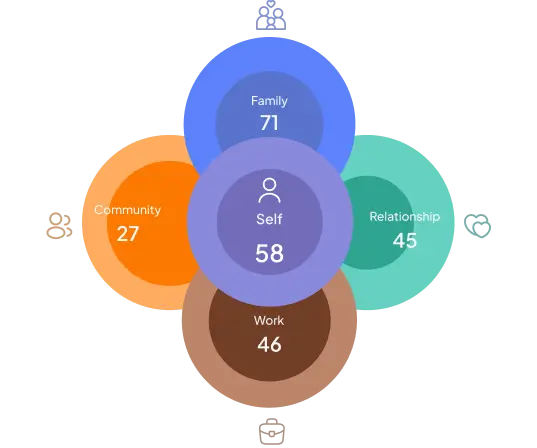
Self
Family
Relationship
Work
Community
What does it mean to be centered?
Centeredness reflects the balance within and between all five spheres, a measure of how integrated your life actually is.
Life will test that balance. But Centeredness is what allows you to absorb disruption, maintain equilibrium, and grow through difficulty rather than merely survive it. Like a tree with deep roots, the strength is not in rigidity. It is in the capacity to bend and recover.
Centeredness Theory tells us that by setting thoughtful, value-aligned goals and taking meaningful action across all five spheres, we don’t just endure. We flourish.
The distance between where you are and where you want to be may be closer than you think, and the research says you can close it.

Rigorous science. Real-world tools.
We don’t ask you to take our word for it. Centeredness Theory has been tested through rigorous scientific validation, so every tool on this platform is grounded in evidence you can trust.
Validating the path to wellbeing
Our validation process began with research validated in partnership with Neuroscience Research Australia (NeuRA). These studies drew participants from 38 countries, reflecting a broad spectrum of backgrounds and life circumstances. Through a rigorous psychometric process, we confirmed the validity of the 60-item Centeredness Theory scale, the scientific backbone of everything MAP does.
488 respondents from 38 countries completed the assessment.
Factor modeling confirmed that MAP's five spheres and 20 dimensions are statistically robust.
The strongest 60 items were selected through systematic statistical analysis.
Peer-reviewed, published, and recognized
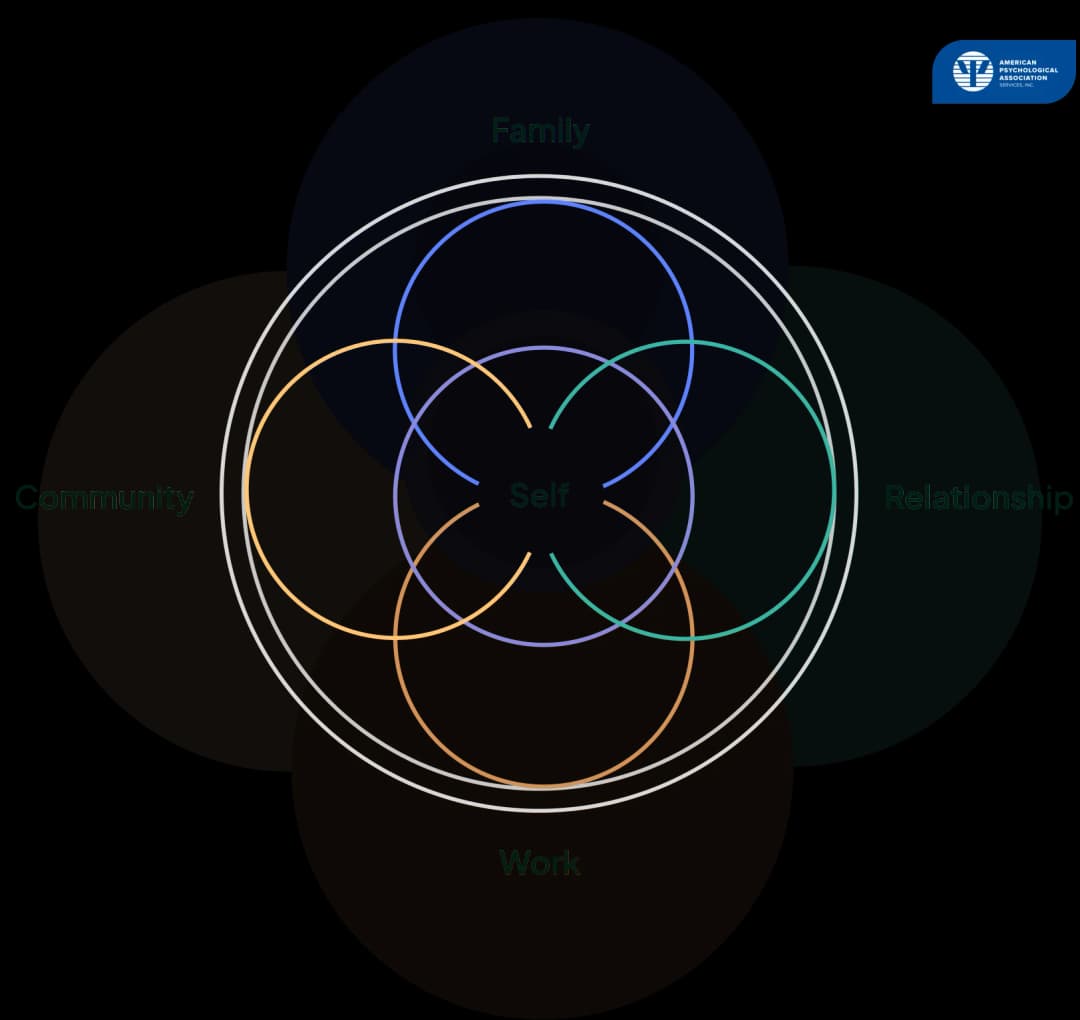
In 2018, the results of this research were published in the open-access, peer-reviewed journal Frontiers in Psychology. The Centeredness Theory scale was subsequently listed by the American Psychological Association.
Since then, the framework has been applied in practice across a range of healthy and clinical populations, from brain injury rehabilitation to caregiver wellbeing.
Curious to go deeper? Explore the published research, or see how the theory translates into your personal wellbeing profile. You can complete it in under five minutes, and it’s completely free.
A theory applied across populations
Explore the latest research on Centeredness Theory and its real-world applications.
Researchers apply Centeredness Theory to support structured goal-setting among individuals living with traumatic brain injuries, helping them rebuild purpose across life spheres.

During COVID-19, Centeredness Theory guided new research into the wellbeing of caregivers for people with dementia, identifying the dimensions most under strain.

Centeredness Theory extends to younger populations, providing a structured framework for wellbeing discussions and research in school settings.
- Goal-Setting After Brain Injury
Researchers apply Centeredness Theory to support structured goal-setting among individuals living with traumatic brain injuries, helping them rebuild purpose across life spheres.
- Supporting Caregivers Through Crisis
During COVID-19, Centeredness Theory guided new research into the wellbeing of caregivers for people with dementia, identifying the dimensions most under strain.
- Wellbeing in the Classroom
Centeredness Theory extends to younger populations, providing a structured framework for wellbeing discussions and research in school settings.


Analytics That Tell You What to Do Next
Most wellbeing tools stop at describing how you’re doing. MAP’s Centeredness Intelligence goes further. It tells you exactly where to focus for the greatest improvement.
Not all analytics are created equal. Here is the hierarchy, and where MAP sits within it:

Descriptive
A snapshot of where your wellbeing stands today, summarizing current trends and patterns across your five life spheres.
Diagnostic
Goes deeper to identify root causes, revealing why your wellbeing scores look the way they do.
Predictive
Projects where your wellbeing is heading based on historical data and emerging trends in your profile.
Prescriptive
The most advanced tier, and where MAP operates. Centeredness Intelligence synthesizes your data and identifies the specific actions to take for greater balance across all five spheres.

Powered by Centeredness Theory and a dynamic model of wellbeing drivers, MAP’s prescriptive analytics ensures you’re not just reading your data. You’re acting on it with precision.
Our Centeredness Intelligence pinpoints the exact areas where change will produce the greatest effect, so every effort you invest in your wellbeing counts. The result is a level of specificity that most wellbeing tools cannot offer, opening pathways to:
Measurably lower stress
Stronger mental health and resilience
A life that feels genuinely fulfilling
Whether you’re pursuing personal growth or working to improve wellbeing at scale, the effect extends beyond you, rippling outward to the people in your life.
Assessment + Action = Lasting Change
Assessment + Action = Lasting Change
MAP is a platform built to move you from insight to action, from understanding where you stand to building the wellbeing you’re working toward.
The platform includes nearly 50 evidence-based positive psychology interventions, each grounded in peer-reviewed research. Here are three that reflect the depth and rigor of what’s waiting for you.
Intervention 01
Best Possible Self
Envisioning a Brighter Tomorrow
What would your life look like if everything went as well as it possibly could? The "Best Possible Self" exercise asks you to vividly describe that future across your career, relationships, health, and personal growth. Research shows this practice builds lasting optimism, clarifies personal goals, and strengthens motivation by connecting daily effort to a meaningful vision. It is one of the most widely studied interventions in positive psychology, with measurable effects across all five life spheres.
Peer-reviewed and practiced worldwide, this exercise turns aspiration into a structured, science-backed tool for growth.

Intervention 02
Active Listening
The Practice of Genuine Attention
Active listening is the discipline of fully focusing on another person without judgment, interruption, or the urge to formulate a response while they’re still speaking. Rooted in communication research, this practice strengthens empathy, deepens understanding, and builds the kind of trust that sustains relationships through difficulty. Studies consistently show that active listening improves both personal and professional interactions, creating a foundation for connection that goes beyond surface-level exchange.
A small shift in how you listen can reshape how others experience you: at home, at work, and in your community.

Intervention 03
Ikigai
Finding Where Purpose Lives
Ikigai is a Japanese concept that describes the intersection of four elements: what you love, what you’re skilled at, what the world needs, and what you can earn a living doing. When these four overlap, the result is a sustained sense of purpose and direction. Modern research supports what Japanese culture has long understood: people who identify their ikigai report higher life satisfaction, greater resilience, and a stronger sense of meaning across all domains of life.
Ancient wisdom, now measured by science. Ikigai is one of nearly 50 interventions within the MAP platform.

These three are just a preview of what the platform offers
Alongside them, you’ll find a full library of evidence-based practices, each designed to strengthen a specific dimension of your life. From stress reduction to relationship building, from professional engagement to community connection, MAP brings these evidence-based practices together, grounded in peer-reviewed research and designed for meaningful, sustained change.